I have this gut feeling…
When I first wrote about digestion issues in a blog post that wasn't at all about digestion, I received many emails from people struggling with similar symptoms. The advice was great but all over the place, and I didn't know where to start. Some suggested a strict gluten-free diet, accompanied by a specific probiotic, slow chewing, and spinach after each meal. Others sent links to encyclopedia-sized research. But one caught my attention. And although it was pricier to test, it echoed the suspicion I'd had all along:
I'm in the US but when I was in SEA and Europe I didn't get gut symptoms nearly as bad. The quality of the food or maybe the additives used here in the states cause some of the problem. Just a theory.
When I got this email back in December 2024, I didn’t even think I’d be traveling through Southeast Asia and Europe the following year. But I did—and found something that surprised even me. But before that, a pre-story:
IBS or whatever the hell it was
I'd carried my symptoms for nearly two years by the time I decided to make changes. They weren't alarming enough for a hospital visit, but they were annoying nonetheless and made my life harder. It started with dull pain in the upper part of the abdomen. It came when I was hungry, and so I'd eat. But then it would appear again after the meal, and so I'd think I should have fasted longer. No matter what I was doing, it wasn't going away, and after a chat with my ex-wife who'd been going through similar issues, we suspected gastritis. I went to a pharmacy and bought over-the-counter drugs to relieve the pain. That and minor diet changes started to help. But after three or four months, it would come back, so my life turned into seasons, each ending with a couple of weeks of frustration.
I got tired of these cycles after a year or so and went to see a physician. I didn't feel terrible enough to agree to a gastroscopy—where a tiny tube with a camera goes down your throat and into your stomach to find ulcers. As a child, I was traumatized by the procedure, and now I’d think twice before subjecting myself to something like that again. So instead, I did $600 worth of lab tests that didn't reveal gastritis or celiac disease or anything at all, really. The doctor threw her hands up in the air and suggested trying a low-FODMAP diet. I came home and quickly googled it, and either because I felt somewhat better from visiting a doctor or because the diet excluded all my favorite types of food, I decided it could wait another year.
Suspected lactose intolerance

It was my discovery of Lactaid that pushed me into trying a lactose-free diet. Filtering out dairy was a logical next step since lactose intolerance affects two thirds of the population. But saying goodbye to milk, yogurt, kefir, cheese, butter, sour cream, whey protein, and especially ice cream felt impossible. So when I saw my lactose-intolerant friend pair cheese with a pill of lactase enzymes, a light bulb went off in my head. Thus a new era of experiments had begun.
My symptoms had somewhat improved, as the three-to-four-month cycles became longer and less acute. I started hoping there could be an end to all suffering, until one evening I found myself so bloated and with a belly so big I thought I'd swallowed a watermelon. I ran to the kitchen and flung my fridge open, hoping to find the culprit. But there was no lactose to be found. No cheese, no butter, and certainly no ice cream—it was a sad view, and the almond milk on the shelf of the fridge door didn't make it any better.
I got on a low-FODMAP diet
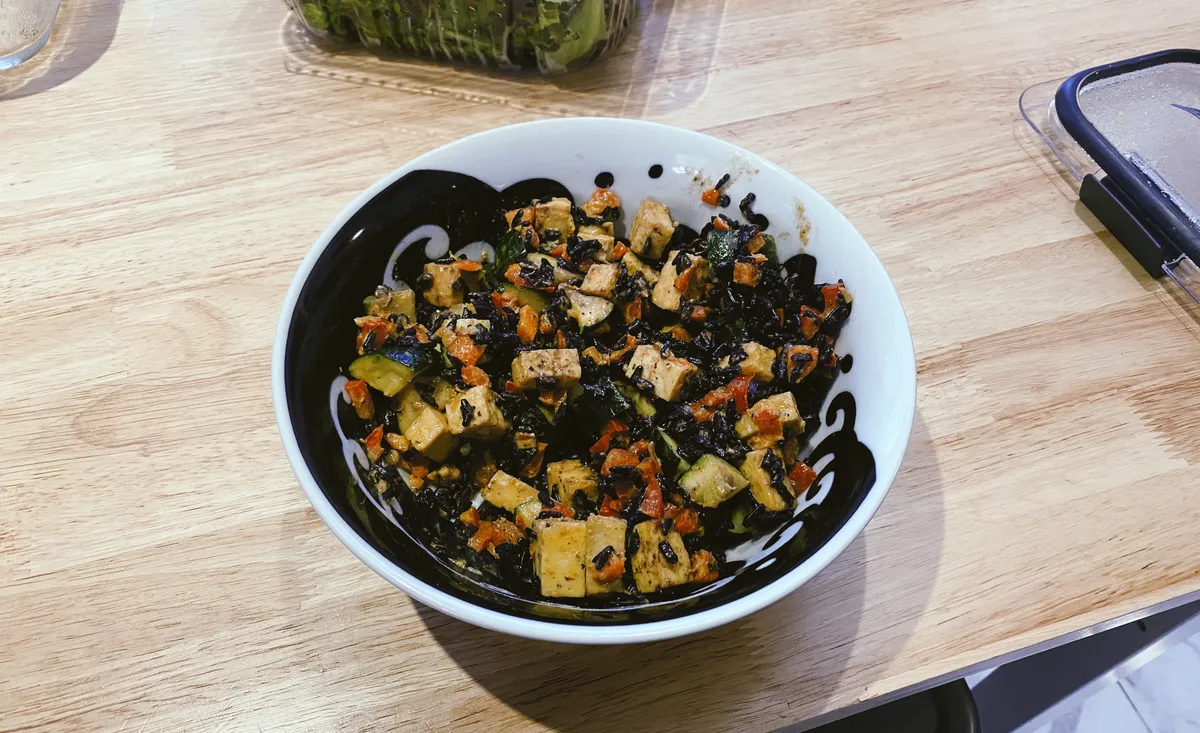
The very next day I went on a strict diet: no dairy, no gluten, no garlic or onion, no fruits, no beans, no chickpeas, no sugar, no alcohol, no avocados. No nothing. For the first two days, I ate quinoa and boiled eggs. The symptoms went away, and I no longer had the brain fog caused by constant thinking about my bloated stomach. I slowly added a few things here and there and ended up with a handful of safe-to-eat, battle-tested foods. For breakfast I had eggs with smoked salmon. My carbs were mostly quinoa—my protein chicken breast and firm tofu. I don't remember having many vegetables during that time apart from boiled carrots, bok choy, and cucumbers. Sometimes I treated myself with the green parts of spring onions. I liked peanuts and walnuts for snacks. Once established, it was a sad but bearable diet, and I kept at it for six months, until I ventured across the ocean.
My symptoms weren’t food-dependent—they were country-dependent
My second day in Thailand was the most memorable of all my days in Thailand as I ended it with a sense of comfort after eating a Pad Thai followed by a scoop of coconut ice cream. Suddenly, I realized I'd forgotten to pay attention to what I was eating—yet my stomach felt great, and so did I. So I remembered advice I’d received in the email and gave myself permission to eat whatever I found appealing.
The next two weeks were a feast to both my eyes and my stomach. Spicy food, fried food, milky food, sweet food, salty food—it all went down and out so smoothly I didn't feel like I was eating at all. There was food I’d never heard of and food I’d only seen in pictures. Yet I had it all and even more and never felt better. As I traveled to Vietnam shortly after, I ran out of Lactaid and visited nearly every pharmacy in Da Nang in a fruitless attempt to find it. So I gave up on my assumed lactose intolerance and prayed the symptoms would never come back. Truly, they never did.
It didn't take me long to conclude that my food intolerances depend on the region I am traveling to. For the half-year spent in Southeast Asia, I forgot I had any issues at all, until in October 2025 I traveled to India, where bloating, constipation, and a heavy feeling in my stomach came flying back. And before it got better (if it got better at all), I tried to enjoy the view of the Himalayas from a rustic toilet in Uttarakhand, as the elevation brought on nausea and diarrhea.

The symptoms eased in Nepal but never fully went away. It left me even more puzzled about what could be the source of the distress. My guesses included water, pesticides, additives and preservatives in food, and imported goods from regions where those pesticides and preservatives are most commonly used. As much as I was enjoying my happy stomach in Chiang Mai or Bangkok, I struggled with bloating in Koh Phangan, where the huge flow of German and Austrian tourists has forced the local cuisine to adapt to Western preferences.
Now, traveling through France, I eat more baguette than I’m comfortable admitting. Europe cares about the quality of food, and I see it in local standards and package labels. The variety of “bio” options is overwhelming, but it shows that people want to know where their greens and proteins come from. Compared to SAD (the Standard American Diet), it feels like a breath of fresh air. I never thought I could eat so much bread and feel so much healthier than on my Canadian diet that mostly consisted of plants. It's absurd. I hope more people will start seeing it as a problem.
Share your gut story with me
Talking about digestive issues is hard. It is as uncomfortable to write about now as it was the first time. This food journey is deeply personal. Asking my roommates to exclude garlic and onion from our communal meals felt like an insult. I was truly grateful but also felt bad because they always tried to accommodate my complicated preferences. Or going to a brunch hosted by my Lebanese friend—who happened to be a remarkable cook—and not being able to refuse any of his signature dishes made almost entirely out of chickpeas. Ah, did my stomach throw me a fit! Yet I couldn't understand what was wrong with me—except that there was nothing wrong.
Seeing how many people resonated with my previous post about gut health, I'm convinced we don't talk about it enough. Sharing experiences helps us—if not to find a remedy—then at least to relieve the discomfort. I'd like to get down to the root cause. Maybe we could make a list of farms and factories to avoid. Or maybe it's already out there and I haven't discovered it yet? Perhaps, like Yuka that detects carcinogens in food and healthcare products, there could be an app to find additives that cause bloating and irritation.
So I encourage you to talk about your experience. If you’ve dealt with anything similar—IBS, bloating, constipation, food intolerances, brain fog, or symptoms that seem to change depending on where you live or travel—I’d genuinely love to hear your story. Even if you don’t have answers. Even if it’s messy. Even if it’s just a few sentences.
If you’re comfortable sharing publicly, post it and send me the link—I’ll add it under this post. And if you’d rather keep it private, you can email me like before.
I'm wishing you all a healthy gut.